

News
- Admission tickets are now on sale.
- The official teaser site is now live.
A night that weaves the beauty of the Hosokawa, and its memory, out of light

Tonight, at Suizenji Jojuen Garden,
a night filled with light begins, tracing the history of the Hosokawa family.
Through the upheavals of the warring states, the Hosokawa nurtured beauty and culture in the land of Kumamoto.
Their radiant path and pride are vividly reflected in light and sound,
together with the shimmer of the water.
May the years they gathered become the light that illuminates Kumamoto's tomorrow.
Lux Night KUMAMOTO is an immersive night walk through Suizenji Jojuen Garden after dark, born from the concept of “going to meet the culture of the Higo Hosokawa”.
After two earlier editions that shone a light on Hosokawa Gracia and Miyamoto Musashi, in 2026 the theme widens to the history of the Hosokawa family itself. From the age of the warring states to the era of the 540,000-koku domain of Higo Kumamoto.
Taming the waters, opening Jojuen Garden, nurturing the tea ceremony, Noh and calligraphy — traces of that path still remain throughout the landscape and culture of Kumamoto today.
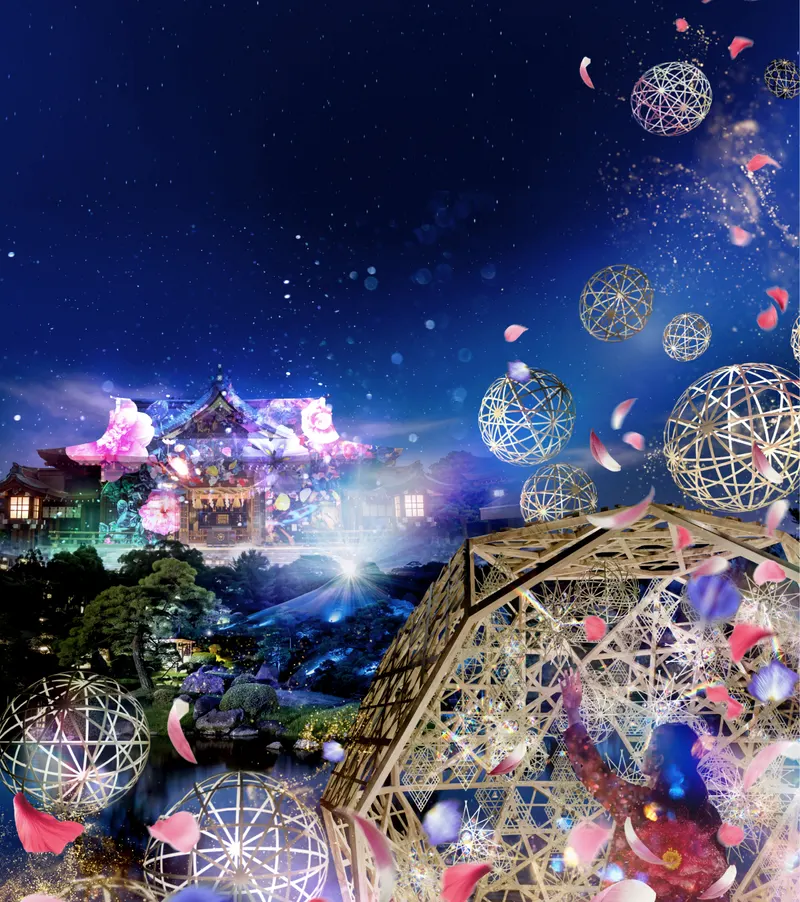
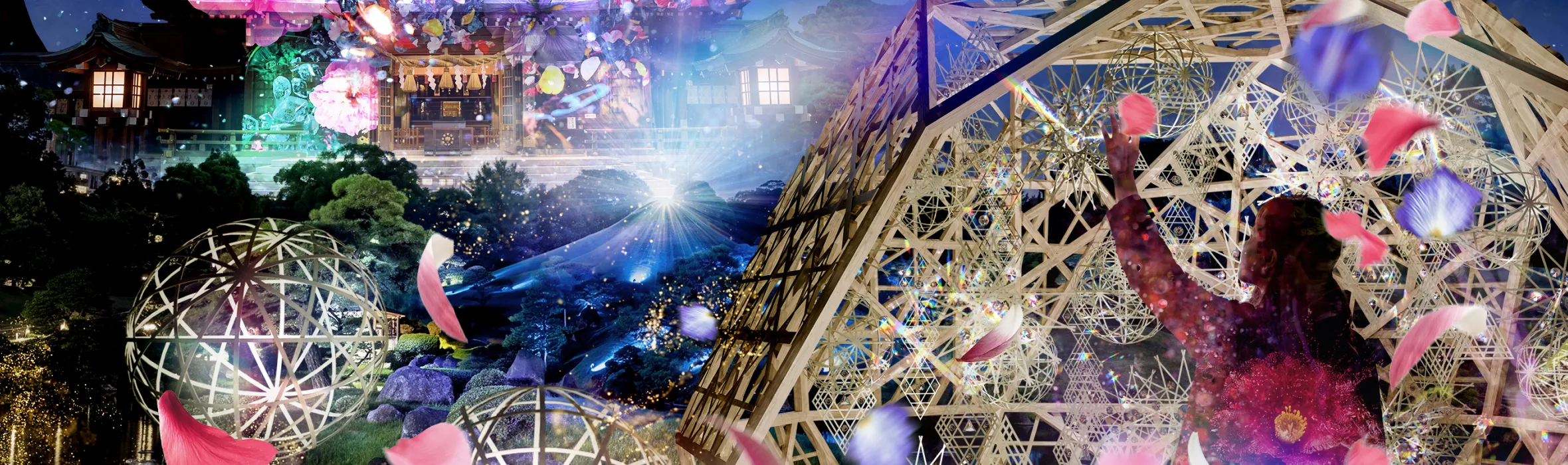
In the garden, bamboo lanterns set with sparkling crystal appear for the first time, alongside installations of flowers and mirrors. Guided by light and sound, enjoy a magical night that follows the history and the pride the Hosokawa family wove.


From Hosokawa Tadaoki, who lived through the age of warring states, to Tadatoshi, who governed the 540,000-koku domain of Higo Kumamoto, and on to Tsunatoshi, who brought Jojuen Garden to completion. Light travelling across the circular forms traces the path of the Hosokawa family from an age of arms to an age of culture. History is not sealed away in the past; it flows into nameless days and shapes the face of a place. Beyond the light lies the time that reaches the Kumamoto of today.

Tadaoki was a warlord who lived on the battlefield, and a man who faced the stillness of the way of tea just as deeply. LEDs recalling the arc of a blade run in response to the presence of visitors, and their light is passed on to the bamboo lanterns. Is strength only a matter of ferocity? Between the sharpness and the suppleness drawn by a single line of light, the martial and literary spirit the Hosokawa cultivated, and the quiet dignity that remains in Kumamoto, rise into view.

Groundwater from Aso circles the earth and wells up to fill Jojuen Garden. This landscape, drawn together in the time of Tsunatoshi, is rendered in water and ripples that answer the movement of those who walk here. A single drop becomes a current, moistens the land, and nurtures daily life and culture. How distant is the time that the water beneath our feet connects us to? The wavering light widens that question in silence.

Tadatoshi set a teahouse here, and the garden was completed in the generation of Tsunatoshi. Its name carries the thought of Tao Yuanming: that walking a garden day after day is what gives rise to its charm. Polyhedra of bamboo and Swarovski crystal, and bamboo spheres that change their glow at a touch, are crystals of the beauty of this land, born where nature, people and passing years overlap. Not a garden to look upon, but one whose time you step into.

The way of tea, Noh, waka poetry and calligraphy. The culture the Hosokawa family held dear took root in Kumamoto not only as brilliant achievement, but as a mind that looks deeply into things and sets them in beautiful order. Light spreading from a great bloom at the centre out into the bamboo grove, and bamboo work linked like a mandala, show a single sense of beauty extending its branches across time. Culture blooms anew, again and again, within each person who receives it.

Izumi Shrine was founded after the Satsuma Rebellion to calm troubled hearts and to wish for the future of Kumamoto. The memories of arms and culture, of water and garden, gathered while walking the grounds are bound here into a single scene. Press your palms together, and light spreads from the hall in answer to your prayer. To honour the past is also to think of what is to come. The final scene is completed by each person who stands here.

A moon of light floats before the pond. Beyond it, a hill shaped after Mount Fuji stands quietly. Lay moon and mountain over one another across the water, and a depth that belongs to this night alone appears in the familiar scenery of Jojuen Garden. The moon waxes and wanes, the seasons turn, people and eras pass. And still, some views are handed on. The instant you capture in a photograph binds this garden to a time of your own.
Takeakari is made by cutting holes and slits into bamboo — a material long woven into Japanese life and culture — and lighting it from within with candles or LEDs. In recent years, festivals celebrating takeakari have been held across the country, with increasingly elaborate works and staging, and it is taking hold as a new form of Japanese beauty. In Kumamoto, the Kumamoto Kurashibito Matsuri "Mizuakari", first held in 2004, is known nationwide as a large-scale takeakari festival.


Saturdays, Sundays and public holidays only
17:00–21:00 (last entry 20:00)
¥500 per visit (tax included)
Adults ¥2,000 (¥1,800 online) High school students ¥1,000 (¥900 online) Junior high and younger free
Tickets can be bought at the entrance with cash or credit card.
The entrance is expected to be busy, so we recommend buying online in advance at a discount.
Suizenji Jojuen membership cards cannot be used for admission to Lux Night KUMAMOTO.

Tickets on sale now Ticket on sale now
Buy tickets Click here to purchaseSuizenji Jojuen Garden
8-1 Suizenji Koen, Chuo-ku, Kumamoto 862-0956
Airport limousine bus to Suizenji Koen-mae (about 30 min)
Tram from Kumamoto Ekimae to Suizenji Koen, then 5 min on foot (about 37 min)
Bus from Kumamoto Ekimae to Kokufu or Suizenji Koen, then 5 min on foot (about 35 min)
Tram from Kumamotojo / Shiyakusho-mae to Suizenji Koen, then 5 min on foot (about 22 min)
Bus from Shiyakusho-mae to Kokufu or Suizenji Koen, then 5 min on foot (about 18 min)
A: Cash and credit cards (VISA, Mastercard, JCB, AMEX) are accepted on the day. Same-day tickets are ¥2,000 for adults, but if you buy online in advance the price is ¥1,800. (For high school students, ¥1,000 on the day and ¥900 online in advance.) The ticket window is also expected to be busy and you may have to queue. With an online ticket you only need to show your code to enter smoothly, so we strongly recommend buying in advance.
A: Yes. Please speak to a member of staff at the entrance when you leave temporarily.
A: It depends on the site you bought it from.
Sanko Marketplace: change the date on their website by 23:59 on your original visit date.
kkday: your ticket can be used on any other day within the event period as it is.
A: No. Refunds are not available from any of the selling websites.
A: Yes, under the following conditions.
(1) Holders of a disability certificate, rehabilitation certificate or atomic bomb survivor health certificate (the holder plus one carer)
(2) Residents of a relief facility, support facility for people with disabilities, child welfare facility or elderly welfare facility, with a document confirming this (the resident plus one accompanying person). For (1) and (2), admission is ¥1,000 (please show the certificate at the entrance, where you can then buy the ticket).
A: No. Please pay the Lux Night Kumamoto admission fee.
A: For enquiries about admission tickets, please write to agent-kumamoto@kyusanko.co.jp.
A: It depends how you enjoy it, but walking the route takes at least 40 minutes.
A: Pets are allowed if carried in your arms or in a carrier. Assistance dogs are also welcome.
A: Yes, but please take your rubbish home with you.
A: Not inside the venue, but there are shops on the approach at the entrance.
A: Yes, from the main gate. Please ask the staff at the window.
Please take care: the ground is dark, and there are gravel paths and slopes.
A: No.
A: There are free coin lockers to the left of the main gate. They take a ¥100 coin, which is returned when you collect your belongings. Please note that they may all be in use.
A: Yes. Please take care not to disturb other visitors.
A: There is no dedicated car park at the venue. Please use a paid car park nearby, or the temporary car parks available on Saturdays, Sundays and public holidays. Spaces in the temporary car parks are limited, so please come by public transport wherever possible.
Please note that we accept no responsibility for any trouble in the car parks.





Kumamoto International Convention & Tourism Bureau
TEL: 096-359-1788 (weekdays 8:30–17:00)
Suizenji Hosokawa Culture Centre, Yusuitei
TEL: 096-285-8893 (9:00–21:00, during the event only)